Why Harvy
It started with a welder in Santa Barbara.
Every company has a founding story. Ours has a grandfather in it.
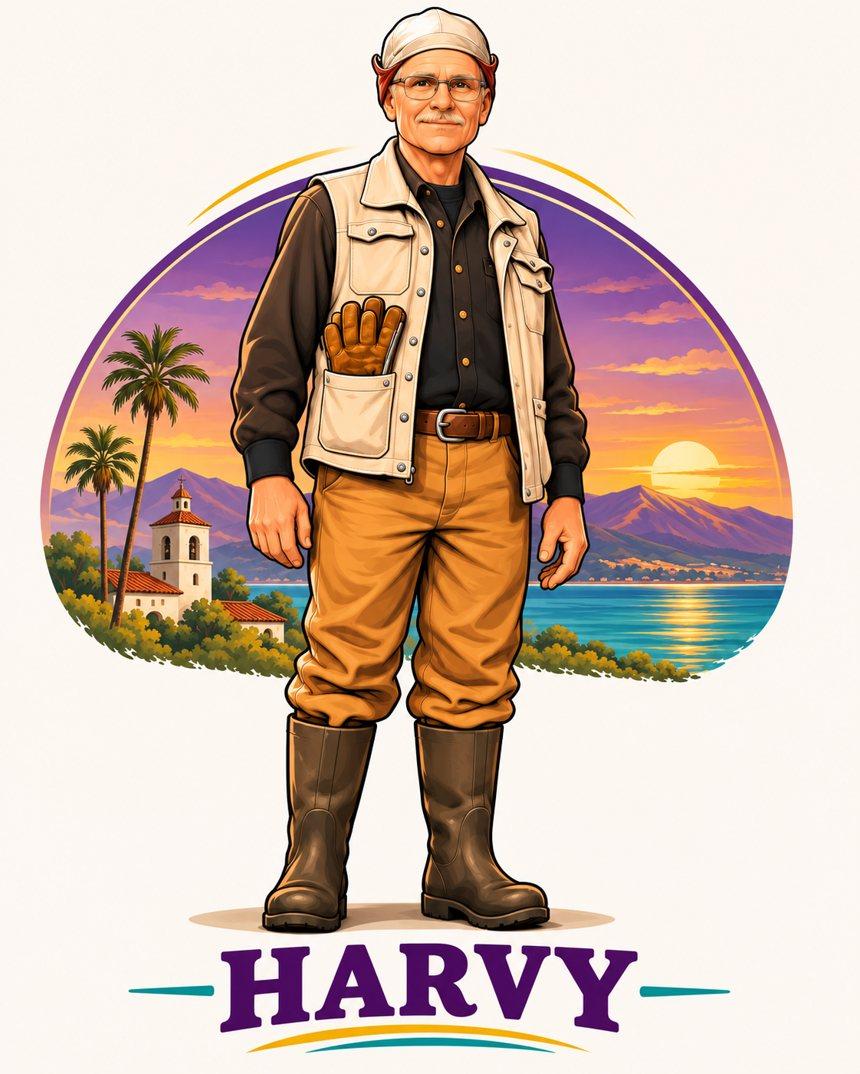
Harvy. Welder. Santa Barbara, California.
Part one
The story of Harvy
My grandfather Harvy owned a small welding business in Santa Barbara. He ran the whole thing on paper: jobs in a ledger, invoices by hand, phone numbers in a book he kept by the register. Not because he was stubborn about it. Because every time he tried to let a computer help, it asked more of him than it gave back.
He trusted technology. He just never got the chance to understand it. Each new thing that came into his life, a computer for the books, a phone that did more than call, arrived with the same promise: this will make it easier. It rarely did. The software was built for someone else. The manual assumed you already knew. And the people selling it had a reason to keep it that way, because a confused customer buys more help, more upgrades, more of whatever is on the shelf that month.
He used to come into our shop all the time, and not because his grandson worked there. He came in because he was frustrated. Something on the laptop had stopped making sense, or the phone had quit doing the one thing he needed it to do, and he'd had enough of people who wouldn't slow down. Our guys loved when he walked in. Not because the problems were interesting. Because he was. He'd ask about your day and mean it, remember what you'd told him last time, and leave you better than he found you. The technology was never the point. It was the excuse for a good conversation, and for him, that was the whole value of it.
Joey, our manager, still tells one story. Harvy came in with his flip phone. He wanted to send a photo to my grandmother and couldn't figure out how, and nobody he'd asked had bothered to show him. Flip phones were already on their way out, and it would have been easy to say so. Joey didn't. He sat down next to him, found the photo, walked through each button with him, and then had him send a second one on his own to make sure it stuck. Harvy talked about that for years. "Joey's a good dude," he'd say, every time it came up.
That was the thing. What frustrated him wasn't the machines. It was being handed off. Someone fixing the error on the screen without ever asking what he was actually trying to do. Someone talking fast and leaving. Our team was different. They sat down. They asked what he was really after. Then they fixed that. He noticed, and he never stopped saying so.
Harvy is named for him, and it was built the way he was helped. Ask what the person is trying to do. Explain it in words they'd use. Make the tool serve the human, not the other way around. If he could have walked into the Harvy portal, it would have told him what was going on in plain English and let him fix it himself, and if he still wanted to come by the shop, that would have been fine too.
Part two
How we got here
I started out as a kid in Alaska, and I can still see the computer store. I'd saved up, I'd been looking forward to it for weeks, and I walked in to find half the display machines broken, the other half dirty, and nothing I touched doing what it was supposed to do. When I finally found a salesperson, he couldn't tell me what I was looking for, and didn't ask. I walked out disappointed, and somewhere on the way home a thought landed that never left: there has to be a better way to do this for people.
That was the first draft of Solutions IT. Not a business plan. A kid who wanted the store to be what it had promised to be.
In 2007 I was knocking on doors in The Dalles, Oregon, doing computer repair for whoever would let me in. No empire, no plan beyond the next house. Just someone who understood the machines and liked the people who owned them. That turned into a counter inside a local print shop, then a second location in Hood River, and in every business I walked into I saw the same gap: nobody needed their computer fixed as much as they needed someone to run the whole thing, and there was nobody to call.
So we built Solutions IT around what small businesses actually needed. Backups that worked, tools people could use, connectivity that stayed up, and support that showed up. We got good at it, and our customers stayed with us for years.
But the industry kept getting more complicated, not less. More vendors, more tools, more line items. Enterprise software got all the attention, and the businesses we served were left to piece it together or pay someone to hold the pieces. We were that someone, and I didn't love it. We were selling peace of mind and delivering dependence.
Harvy is what came out of that, and out of a welder who deserved better. Everything Solutions IT learned in nearly two decades, put into one portal a business owner can run themselves, in plain English, with the licensing included and a real person on the phone when they want one. The door-to-door guy never stopped showing up. He just built a better way to do it.